
Opposition’s ‘Chalo Delhi – March for Democracy’ to Supreme Court Demands CEC Resignation Amid SIR ‘Vote Theft’ Allegations…
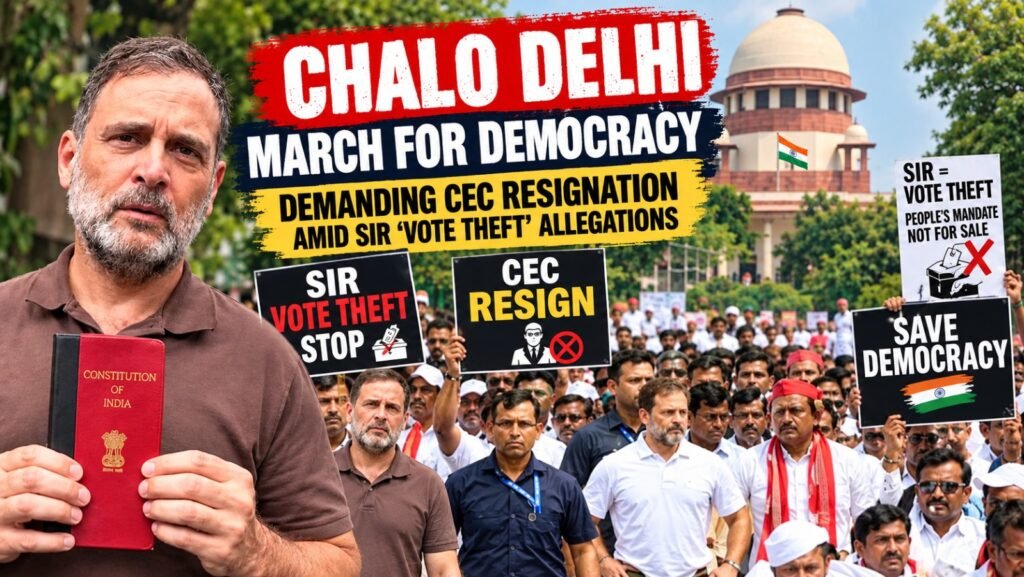
The country’s political landscape is witnessing a major political battle today. Opposition parties, led by the Congress and the India Alliance, are organizing a massive protest march from Parliament to the Supreme Court in Delhi today, Monday, October 12, 2026, to press their demands. The opposition has dubbed this movement “Chalo Delhi – March for Democracy.” The primary objective is to raise voices against alleged irregularities and “vote theft” in the Special Intensive Revision (SIR) of the electoral rolls and to demand the resignation of Chief Election Commissioner (CEC) Gyanesh Kumar. Leader of the Opposition in the Lok Sabha, Rahul Gandhi, has appealed to youth, civil society organizations, and all opposition parties to join this peaceful march. According to party sources, opposition party leaders and workers will gather at the Connaught Place-Barakhamba Road intersection at 1:30 pm and march towards the Supreme Court. Several prominent opposition leaders, including Congress President Mallikarjun Kharge, Rahul Gandhi, Priyanka Gandhi Vadra, Samajwadi Party chief Akhilesh Yadav, and Trinamool Congress (TMC) chief Mamata Banerjee, are expected to participate in this march. In view of this major opposition movement, the Delhi Police and security agencies have tightened security across Delhi. Heavy barricades have been erected across central Delhi, and Rapid Action Force (RAF) and CRPF personnel have been deployed. To maintain security and law and order, the Delhi Metro Rail Corporation (DMRC) has decided to close the entry and exit gates of six major metro stations from 6:00 am to 4:00 pm. These stations include Rajiv Chowk, Mandi House, Central Secretariat, Patel Chowk, Janpath, and Barakhamba Road. Meanwhile, the opposition has received a major setback from the Supreme Court. Opposition leaders Rahul Gandhi and Mallikarjun Kharge had sought time to meet with Supreme Court Chief Justice (CJI) Surya Kant to submit a memorandum. However, CJI Surya Kant has refused to meet with the opposition leaders.According to sources, the Chief Justice stated that since the matter is already sub judice, the executive cannot be interfered with at the administrative level. He advised the opposition to file a petition on the judicial side, which is expected to be heard on Tuesday.
CJI Highlights Public Trust as the Foundation of a Strong Judiciary…
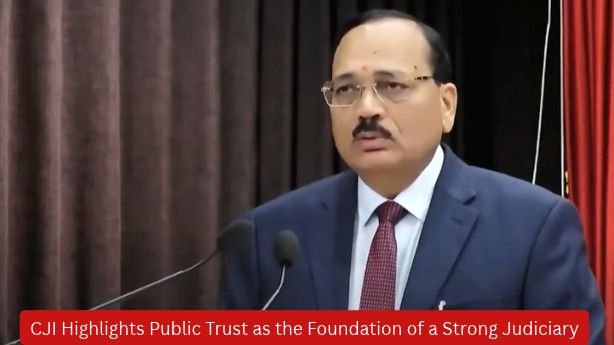
Chief Justice of India Surya Kant has said that public trust is the real strength of the judiciary and that courts cannot build confidence simply by delivering judgments that people like. Speaking at the 6th Ram Jethmalani Memorial Lecture in New Delhi on Monday, the CJI said trust comes from ensuring a fair and transparent judicial process, even when a decision goes against the expectations of those involved. Justice Kant made a clear distinction between public trust and public approval. He said a court does not earn people’s confidence by giving them the outcome they want, but by making sure that even those who lose a case feel that the process was fair. He also stressed that transparency goes beyond holding open hearings. According to him, people should be able to understand and examine the reasoning behind a court’s decision, not just its final outcome. The CJI also spoke about the need for the judiciary to remain open to scrutiny, questions and constructive criticism. Referring to the recent debate surrounding an NCERT textbook and references to judicial corruption, he said institutions do not remain credible by shielding themselves from criticism, but by facing scrutiny and demonstrating their integrity. He described public trust as something that has to be earned and renewed continuously through the everyday functioning of the justice system. Addressing concerns about judicial accountability and administrative reforms, Justice Kant said reform should be a continuing process and no institution can afford to remain static. He said the Supreme Court and High Courts already have mechanisms to deal with complaints against judges, describing them as robust and responsive, while also acknowledging that such systems can be improved. He cautioned, however, that putting every complaint against a judge into the public domain could itself raise concerns and argued for a strong internal mechanism capable of examining complaints objectively and responsibly.