
Gujarat Becomes Second State After Uttarakhand to Get Presidential Assent for Uniform Civil Code…
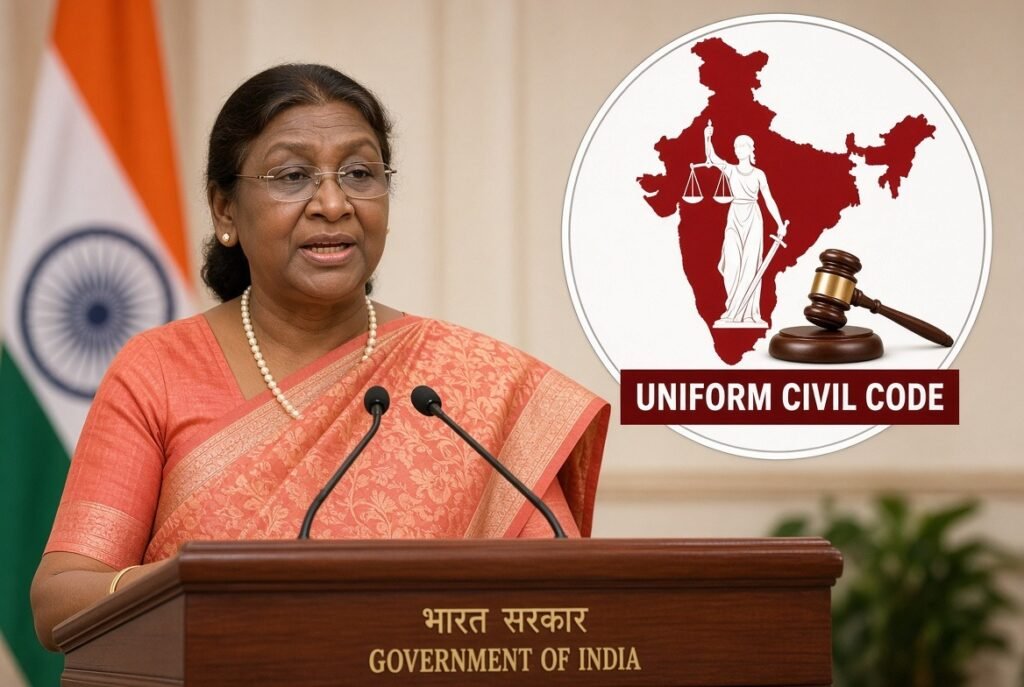
President Draupadi Murmu has approved the Gujarat Uniform Civil Code (UCC) Bill, 2026. According to Rashtrapati Bhavan records, the approval was given on September 17, 2026, and the bill was published in the Gujarat Extraordinary Gazette on October 1. With this, Gujarat becomes the second state, after Uttarakhand, to receive presidential assent to the Uniform Civil Code. The Gujarat Assembly passed the bill in March 2026 after nearly eight hours of discussion. The law proposes a uniform legal framework for civil matters related to marriage, divorce, inheritance, adoption, and live-in relationships. Scheduled Tribes and certain communities protected under Part XXI of the Constitution are excluded from its scope. Key provisions of the law include registration of marriages, prohibition of polygamy and bigamy, and equality of property rights for sons and daughters. Provisions are also made for the registration of live-in relationships and the rights associated with them. However, for the actual implementation of the law, the state government will have to notify rules. The decision has also sparked political reactions in Gujarat. The ruling BJP has hailed it as a step towards equality and women’s rights, while the Congress has questioned the process and necessity of passing the bill.
Assam Assembly Introduces UCC Bill 2026 with Rules on Marriage, Divorce and Live-in Relationships…

Assam’s Parliamentary Affairs Minister, Atul Bora, introduced the Uniform Civil Code (Assam) Bill, 2026, in the state assembly. The bill reportedly establishes a uniform age for marriage at 21 years for men and 18 years for women. It also prohibits polygamy and mandates registration for those in live-in relationships. Different regulatory mechanisms and penalties have been implemented across the state for this bill. Key regulations include requiring couples in live-in relationships to register their partnership within one month, and any child born to a registered live-in couple will be legally legitimate. Minors entering into such relationships will face prosecution, and if either partner is already married, the partnership will be considered valid. The bill mandates registration of all divorce cases, whether a ceremony or order, within 60 days of marriage and divorce. Scheduled Tribe communities and their traditional customs are exempt from this law. Violations of the law will be punished Anyone who does not comply with this legal proposal will be punished with imprisonment up to 3 months and a fine of ₹10,000, anyone who conceals facts after the declaration will be punished with imprisonment up to 3 months and a fine of ₹25,000, and also a fine of ₹10,000 for not registering the marriage or divorce within 7 days, and tampering with the document during registration will be punished with imprisonment up to 3 months and a fine of ₹25,000.