
PM Modi inaugurates SEMICON India 2026, says India’s chip story has moved from files to factories…
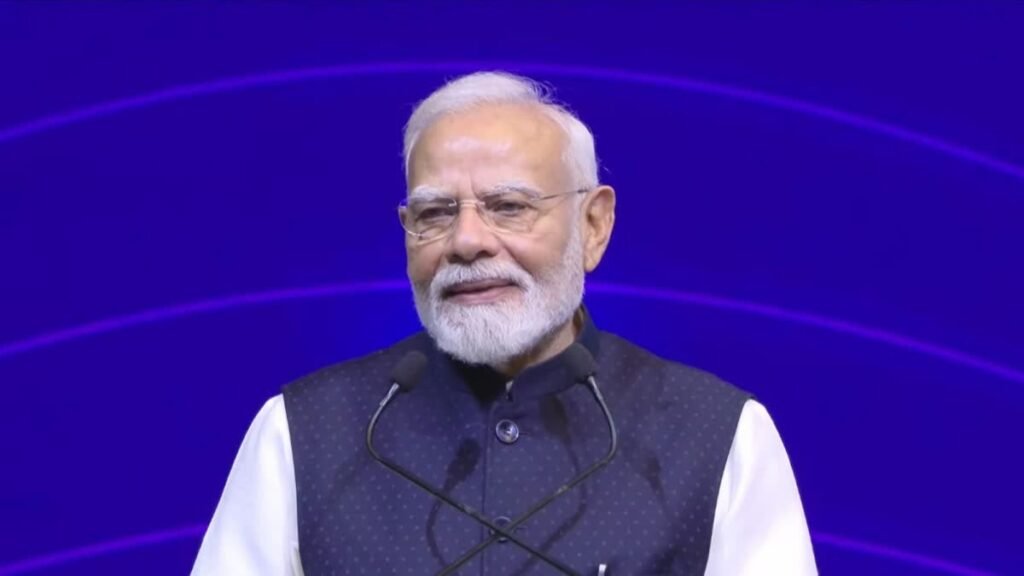
Prime Minister Narendra Modi inaugurated the fifth edition of the global semiconductor summit “SEMICON India 2026” on September 17th at the Yashobhoomi Convention Center in Dwarka, New Delhi. This three-day event, held from September 17th to 19th in the capital, New Delhi, focuses on industry participation, policy direction, and international partnerships. This mega-event brings together leading tech leaders, scientists, and investors from around the world to strengthen India’s semiconductor ecosystem. The theme of this year’s summit is “Silicon to Systems: Building the Ecosystem.” According to the Ministry of Electronics and Information Technology (MeitY), the conference is being jointly organized by the India Semiconductor Mission (ISM), MeitY, and the global industry body SEMI under the theme “Silicon to Systems: Building the Ecosystem.” Addressing the inaugural session, Prime Minister Modi said, “India’s chip story is no longer confined to files, but has reached the ground in factories. India will soon become an integral and reliable part of the global semiconductor supply chain.” Highlighting the progress made in the country’s electronics and chip manufacturing sector, the Prime Minister said that India is now fully prepared for the next phase of the semiconductor sector, ‘Semicon 2.0.’ The Indian government aims to not only meet the country’s domestic chip needs but also export chips globally for the mobile, automobile, and AI sectors. Prime Minister Narendra Modi said that amid these achievements, the Semicon India event has become even more important. The first edition was held in 2022, and since then, we have been meeting every year, but the topics of our discussions have changed each year. In the first edition, we discussed policy. The discussions progressed in subsequent editions. We began discussions on projects, including signing files and laying foundation stones. Last year, we began discussions on pilot lines and test chips, and talked about the first samples coming out of Indian units. This year, we are talking about commercial production. Our chips are now reaching customers across the country and the world from Indian plants. Two more plants are also starting commercial production. I congratulate them as well. The event will also feature an official review of key manufacturing achievements. Under the ‘Semicon India Program,’ the central government has approved 12 semiconductor projects, of which commercial production has already begun at three units approved under ‘Semicon 1.0.’ Furthermore, the Union Cabinet has approved the next phase, called ‘Semicon 2.0,’ which is based on six key pillars. Electronic design automation tools have been delivered to over 400 academic institutions and 105 startups, while 24 startups have received approval under the ‘Design Linked Incentive’ scheme. In this regard, the ministry said that SEMICON India 2026 will adopt a comprehensive value-chain approach, showcasing the journey from semiconductor materials and manufacturing to advanced packaging, design, electronics and systems.
Congress Workers March to CM Residence in Dehradun Amid Heavy Rain…
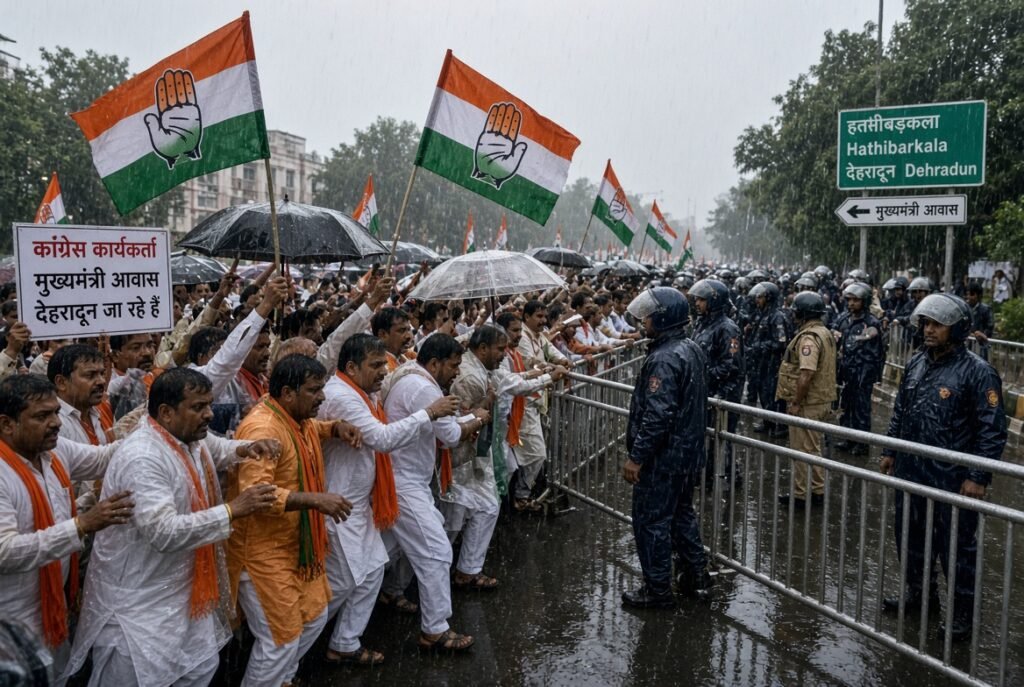
Congress workers marched to the CM’s residence in protest against purification drive in Haldwani on September 7th, amid heavy rain. A large number of Congress leaders and workers joined the march to the CM’s residence. Police erected barricades near Hathibarkala to stop the protesters. A scuffle broke out between Congress leaders and police. During the siege of the CM’s residence, in the presence of Uttarakhand in-charge Kumari Selja and other senior leaders, several people joined the Congress party. Those who joined the party included Yashpal Rana, former Mayor of Roorkee, Bhuvnesh Kharkwal, former Chief of Yamkeshwar, Kotdwar, Manoj Saini, former Principal and former Chairman of the Sugarcane Committee, Haridwar, Ramkumar Walia (former Minister of State), Ravindra Anand (former Chairman of the Mandi Committee, Dehradun), and Advocate Sachin Kumar of Purola. State in-charge Kumari Selja joined the March State in-charge Kumari Selja alleged that the BJP government betrayed the sentiments of the people of Uttarakhand. After National President Mallikarjun Kharge’s rally, they made their own people perform purification rituals. The BJP is resorting to all kinds of tactics for the upcoming elections. Meanwhile, senior Congress leader and former Chief Minister Harish Rawat observed a one-hour fast at his residence in New Delhi. Harish Rawat has been in New Delhi for the past few months for health reasons. He wrote on social media, “Some unforeseen reasons and invisible forces are repeatedly creating such a situation that I am unable to muster the courage to travel to Uttarakhand. A struggle is underway in Uttarakhand against the forces that patronize untouchability and degrading casteism. To register my participation in this struggle, I will observe a one-hour fast at my Delhi residence on September 7th and pray to God to defeat the forces that perpetuate untouchability and social discrimination.”
CM Dhami to arrive in Nainital on a one-day visit, lay foundation stone for Sports University
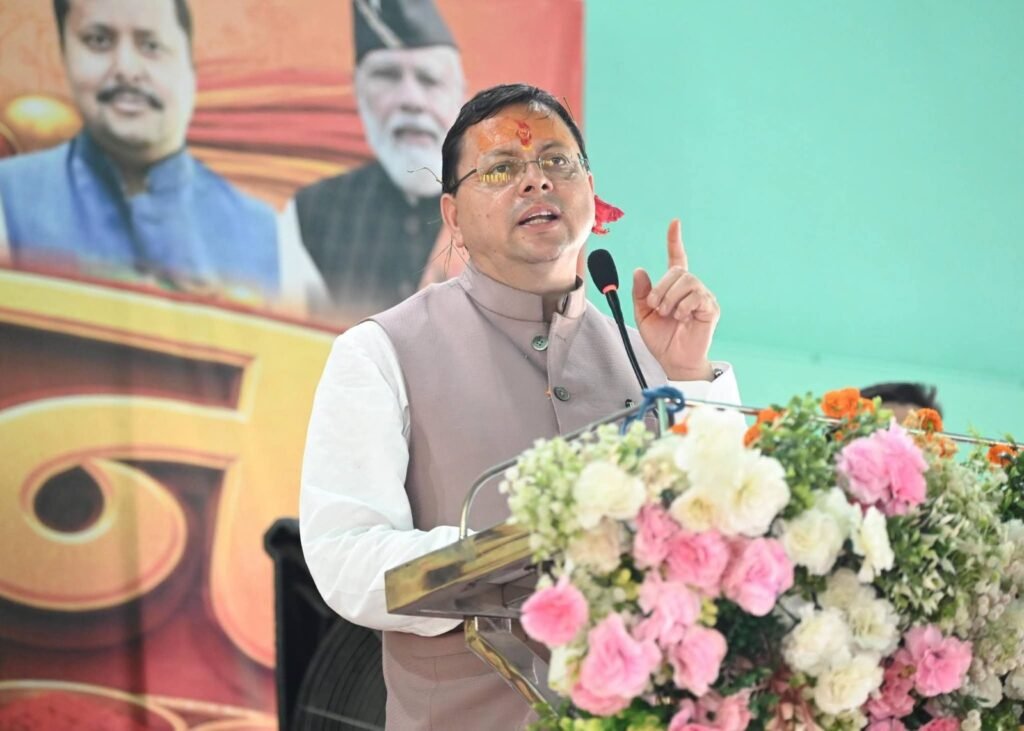
State Chief Minister Pushkar Singh Dhami will arrive in Nainital on Saturday, August 29th, for a day-long visit. The district administration has released the schedule for the Chief Minister’s visit. According to the schedule, CM Dhami will depart for Haldwani Gaulapar via helicopter from the DPS School grounds in Rudrapur in the morning and arrive at the Gaulapar Stadium helipad at 12 noon. The Chief Minister will then depart by car for the Uttarakhand State Sports University. Five minutes later, he will arrive at the university campus to attend the ceremony. He will also participate in the groundbreaking ceremony and foundation stone laying ceremony of the Uttarakhand State Sports University, as well as the National Sports Day ceremony, and will depart from the Sports University for ITDC Fortune in Haldwani at 2 pm. CM Dhami lay foundation stone for Sports University During this visit, the Chief Minister will interact with people from the industry and business world. The Chief Minister will then arrive in the ITDC Fortuner near the District Cooperative Bank in Anand Bagh and participate in the program held there. At 4 p.m., the Chief Minister will depart from Anand Bagh for Mukhani. After attending the program, the Chief Minister will proceed to the FTI helipad, from where CM Dhami will depart for Dehradun by helicopter. It should be noted that Uttarakhand will receive the state’s first sports university on the occasion of National Sports Day. The sports university, being built in Haldwani’s Gaulapar, will benefit the state’s athletes. A grand ceremony will be held at the International Stadium in Gaulapar for the foundation stone laying ceremony of the sports university, for which preparations have already been completed. Additionally, 94 posts, including the Vice Chancellor, have been approved for the sports university.
From Moscow to Beijing, Washington to Tokyo: India’s Top Officials on Coordinated Diplomatic Push…
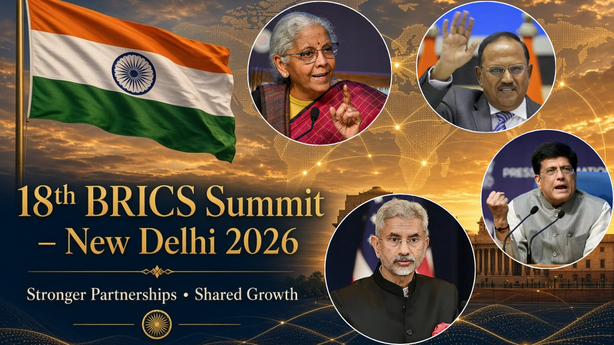
India has intensified diplomatic engagements and bilateral meetings with major global powers to strengthen its position on the global stage ahead of the BRICS Summit. The primary objective is to safeguard its national interests in multilateral forums and maintain balance in the global order. Ahead of the 18th BRICS Summit, scheduled to be held in New Delhi in September 2026, the Indian government has launched a major diplomatic push. Four of India’s most prominent officials and ministers are visiting five key countries to strengthen India’s national interests ahead of the summit. Prime Minister Narendra Modi, along with his three ministers—Nirmala Sitharaman, S. Jaishankar, Piyush Goyal, and National Security Advisor (NSA) Ajit Doval—is leading a major diplomatic campaign. These diplomatic meetings will last for three weeks, concluding in the second week of September, immediately following the BRICS Summit in New Delhi. Finance Minister Nirmala Sitharaman is on a highly important official visit to Canada and the United States from August 25 to September 2, 2026. This visit, taking place just before the BRICS Summit, is considered strategically important for India’s economic diplomacy. Finance Minister Nirmala Sitharaman’s visit to Canada and the United States prioritizes four key agendas: investor meetings, interactions with corporate leaders, strengthening economic ties, and G20 financial discussions. As part of this diplomatic mission, External Affairs Minister Dr. S. Jaishankar recently held a crucial meeting with Russian President Vladimir Putin and Foreign Minister Sergey Lavrov in Moscow. Key areas of economic cooperation, energy and fertilizers, technology and defense were discussed amid preparations for the upcoming Modi-Putin meeting. Commerce Minister Piyush Goyal is also visiting Japan with a large delegation of 200 Indian business leaders and veterans. The main objective of this visit is to enhance India-Japan bilateral trade and attract significant Japanese investment in India’s infrastructure, high-tech manufacturing, semiconductor, and next-generation industries. National Security Advisor Ajit Doval is in Beijing, the capital of China, for the 25th round of India-China Special Representatives’ Dialogue. The main objective of this high-level strategic meeting is to find a lasting solution to the long-standing border issues between the two countries and effectively manage the current tensions along the Line of Actual Control (LAC).
Dhami Approves Financial Sanctions Worth Around ₹135 Crore for Development and Welfare Projects
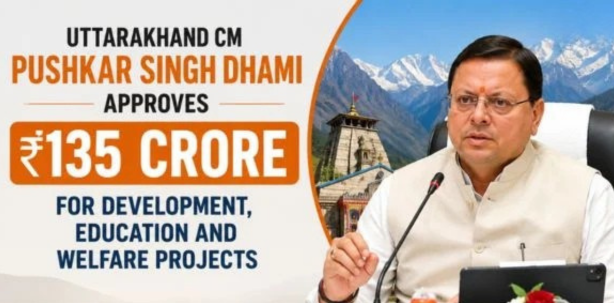
Dhami Approves Financial Sanctions: Uttarakhand Chief Minister Pushkar Singh Dhami has approved financial sanctions of around ₹135 crore for a range of development, education, infrastructure and welfare-related works across the state. The approvals cover projects aimed at strengthening public infrastructure, supporting education and improving administrative facilities. A major allocation of ₹84.89 crore has been approved as the second instalment for the 2025-26 financial year under the Right to Education (RTE) Act. The amount will be used to reimburse tuition fees for eligible students studying in private schools under the RTE provisions. Officials have been directed to ensure timely and transparent utilisation of the funds. Several smaller infrastructure and development works have also received financial approval. These include funds for completing the Mountain Development Building in Sitarganj, construction of a shed at the Martyrs’ Memorial in Khatima and other district-level projects. The government has also sanctioned funds for heritage conservation and beautification works, including projects at temples and historic buildings in different parts of the state. In addition, financial assistance has been approved for strengthening administrative and security institutions, including the Uttarakhand Academy of Administration, Uttarakhand Subordinate Services Selection Commission, police establishments and the Home Guards Department. As part of the approvals, the state government has also decided to name the Moln-Khandah-Bhintai motor road in Pauri Garhwal after martyr Kamala Singh Negi, honouring his contribution and sacrifice. The latest sanctions are aimed at accelerating development works, strengthening public services and supporting education and welfare initiatives across Uttarakhand.
People Will Never Forgive Congress”: Amit Shah Targets Sonia Gandhi Over Vande Mataram Row
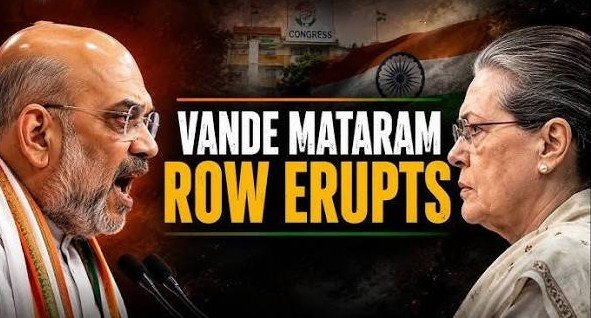
Union Home Minister Amit Shah has intensified the political debate over Vande Mataram, accusing the Congress leadership of disrespecting the national song. Addressing a gathering in Rajasthan, Shah alleged that Sonia Gandhi had asked Congress president Mallikarjun Kharge to stop the rendition of Vande Mataram during the party’s Independence Day programme. He said the people of the country would not forgive Congress for such an act. Amit Shah Demands an Apology Shah criticised the Congress over its position on the national song and demanded that the party apologise to the people of India as well as to the memory of Bankim Chandra Chattopadhyay, who wrote Vande Mataram. The BJP has argued that limiting the rendition of the song amounts to disrespecting a symbol associated with India’s freedom struggle. Congress Rejects the Allegations Congress has rejected Shah’s allegations and defended its position on Vande Mataram. The party has maintained that the song was sung at its Independence Day programme and argued that the BJP is unnecessarily politicising the issue. Congress leaders have also pointed to the party’s historical position on which portions of the song should be performed at official party programmes. 1937 Resolution at the Centre of the Debate The controversy gained further momentum after the Congress Working Committee reaffirmed its historical 1937 position concerning Vande Mataram. The party said the first two stanzas have traditionally been used in national and Congress programmes. The BJP, however, has strongly criticised this decision, turning the issue into another major political confrontation between the two parties. Political Row Continues The dispute over Vande Mataram has now expanded beyond the question of how much of the song should be sung, with both the BJP and Congress using the issue to challenge each other’s positions on nationalism and India’s freedom movement. Importantly, Shah’s claim about Sonia Gandhi directing that the song be stopped remains an allegation disputed by Congress and should not be presented as an independently proven fact. The controversy is expected to remain a politically sensitive issue as both parties continue to trade accusations.
Congress National President Mallikarjun Kharge will visit Uttarakhand and sound the election bugle from Haldwani..
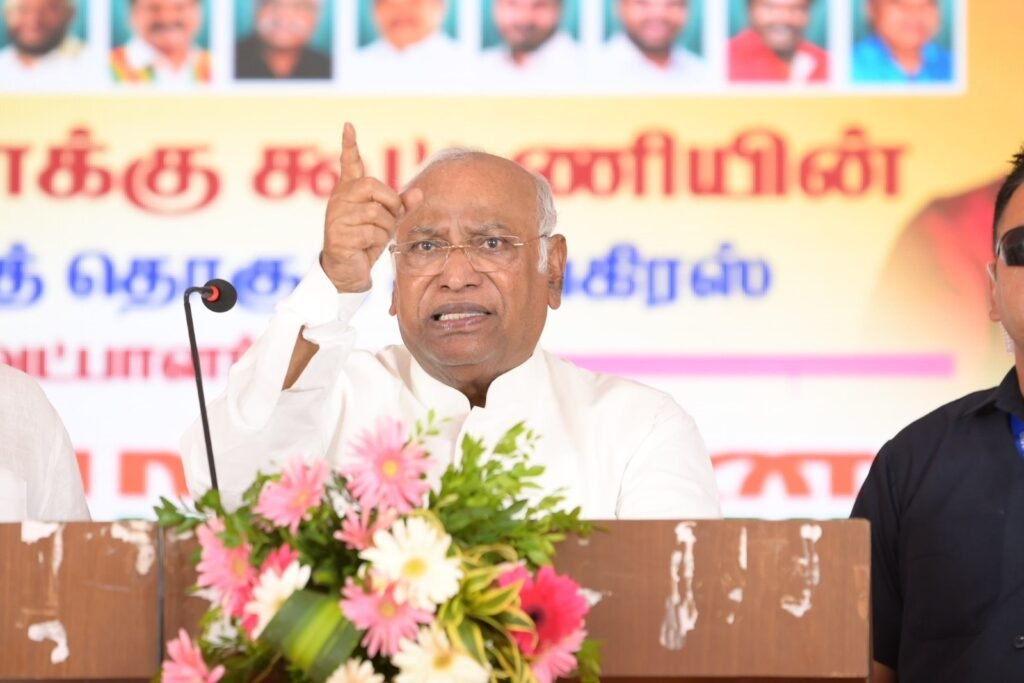
Congress National President Mallikarjun Kharge is visiting Uttarakhand after nearly two and a half years to strategize for the elections. Kharge will launch the Congress election campaign with a rally of party workers at Haldwani’s Ramlila Maidan on August 8th. At the rally, Congress will sharpen the issues of paper leaks, bribe theft, law and order, unemployment, and inflation, and launch a political attack on the BJP. Of the 70 assembly seats in the country, 19 are in the six districts of the Kumaon division. In the 2022 assembly elections, Congress won 19 seats, 11 of which were in the Kumaon division. Following the by-election in the Mangalore assembly seat, Congress gained a one-seat lead. In the Garhwal division, Congress holds only 9 of the 41 assembly seats. Last Wednesday, State Congress in-charge Kumari Selja held a virtual meeting with senior leaders regarding preparations for National President Kharge’s proposed program. She inquired about the preparations from State President Ganesh Godiyal, Leader of the Opposition Yashpal Arya, and other leaders. She instructed party leaders to coordinate and ensure a historic rally. State Congress President Ganesh Godiyal stated that preparations for the National President’s Haldwani rally are being finalized. The party has set a target of 35,000 to 40,000 workers attending the rally. To this end, all party leaders are working to make the rally historic. The national leadership is taking the upcoming assembly elections seriously. Following Leader of the Opposition Rahul Gandhi’s “Chhatra Ki Goonj” program in Dehradun, the National President’s Haldwani rally will sound the election bugle. In the coming days, Rahul Gandhi, Priyanka Gandhi, and other top leaders will hold programs in Uttarakhand. The National President’s visit will inject new energy into the party workers.
Article 370 Abrogation Completes 7 Years: Key Changes in Jammu and Kashmir
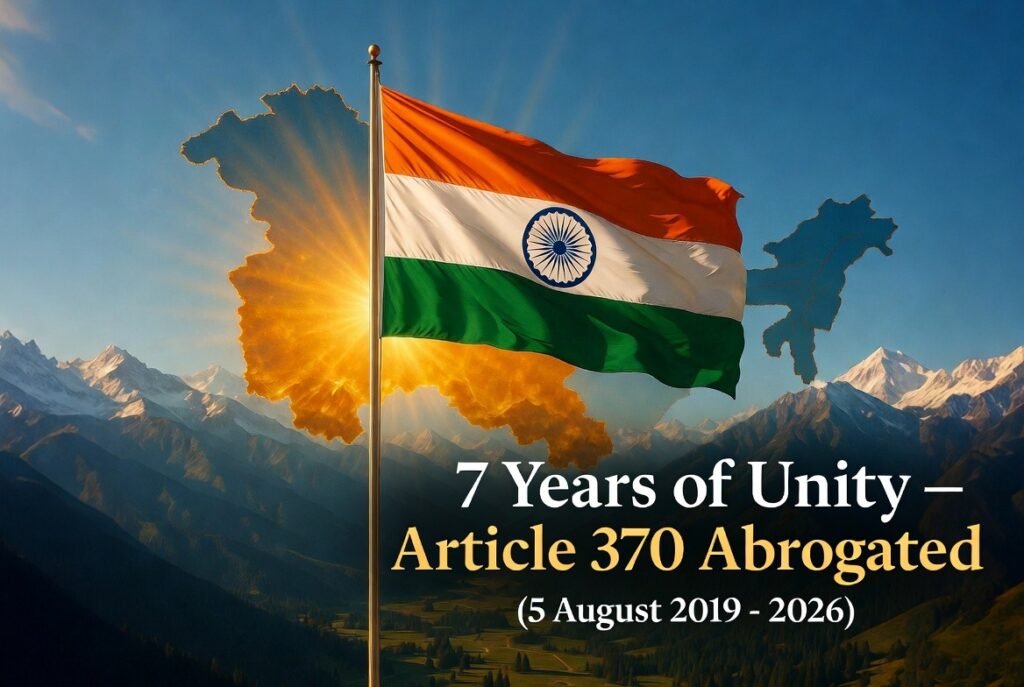
It has been seven years since the destiny of Jammu and Kashmir was transformed. It was on this very day in 2019 that Article 370 and Article 35A were abrogated in Jammu and Kashmir. This is considered the most significant achievement of the BJP government’s tenure. Just months after the NDA government began its second term under the leadership of Prime Minister Narendra Modi, Article 370 and Article 35A—which granted special status to Jammu and Kashmir—were revoked. This is regarded as one of the most secretive strategic missions in the history of Indian politics. Knowledge of the entire operation was confined to a select few—including PM Modi, Home Minister Amit Shah, and National Security Advisor Ajit Doval—and no one else got wind of it. What is Article 370? Article 370 was a temporary provision of the Constitution that granted Jammu and Kashmir a special autonomous status compared to other Indian states. This provision came into effect on October 26, 1947—shortly after India gained independence—and remained in force until August 5, 2019. Under this article, Jammu and Kashmir had its own separate constitution and flag. Except for matters concerning defense, foreign affairs, finance, and communications, the approval of the Jammu and Kashmir State Assembly was mandatory for the implementation of central laws. Furthermore, non-residents of Jammu and Kashmir could not purchase movable property, land, or houses in the region, nor were they eligible for state government jobs. Certain provisions of the Indian Constitution—such as the Right to Education (RTE) and the Right to Property—were not applicable in Jammu and Kashmir under this article. Changes after the abrogation of Article 370 With the abrogation of Article 370, the special status granted to Jammu and Kashmir came to an end. Post-2019, the Indian Constitution became fully applicable in the region. The provisions for a separate constitution and flag for Jammu and Kashmir were also abolished. Non-residents can now purchase land in Jammu and Kashmir, subject to certain conditions. Additionally, citizens of Jammu and Kashmir became eligible to apply for jobs in other states. Jammu and Kashmir was bifurcated into two Union Territories: Jammu and Kashmir, with a legislative assembly, and Ladakh, as a Union Territory without one. While incidents of stone-pelting were previously common in the region, the youth of Jammu and Kashmir began joining the Indian Army following the abrogation of Article 370. Terrorist incidents in the region also declined.
Brij Bhushan Sharan Singh Acquitted by Delhi Court in Wrestlers’ Sexual Harassment Case..
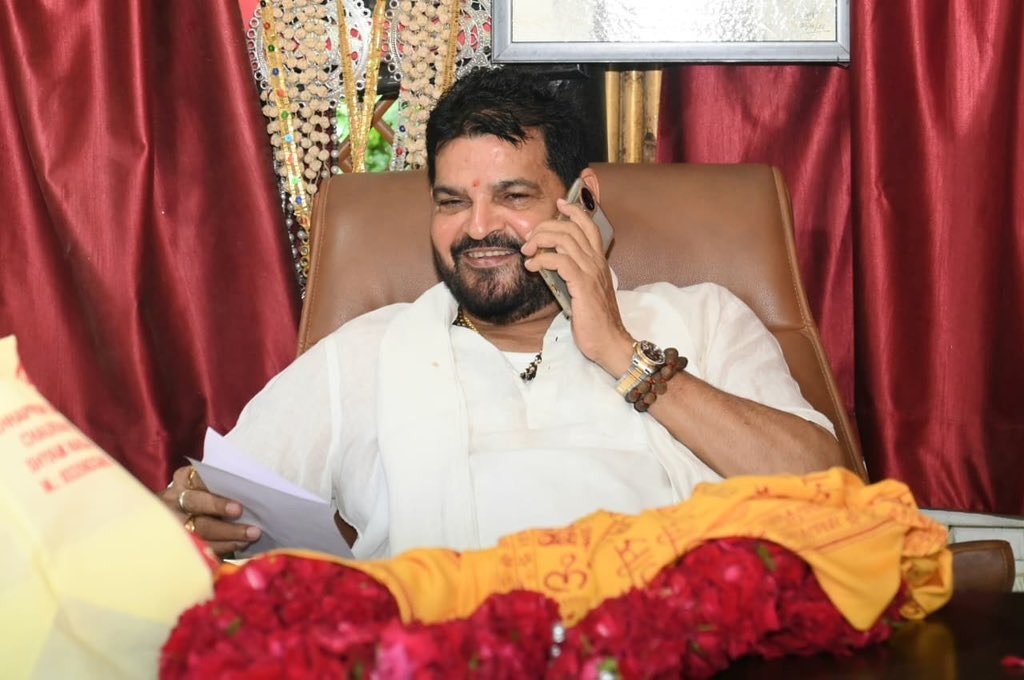
Delhi’s Rouse Avenue Court has acquitted former BJP MP and former Wrestling Federation of India president Brij Bhushan Sharan Singh in the sexual harassment case filed by six female wrestlers. The court gave this decision on Monday i.e. 3rd August. Along with this, the court has also acquitted another accused Vinod Tomar. The hearing of this case related to allegations of sexual exploitation of female players was going on till 2023, the hearing till now lasted for about 1133 days, in which the court heard it 127 times. This sexual exploitation case started on 18 January 2023. Where about 30 wrestlers including female wrestlers Vinesh Phogat, Sakshi Malik, Bajrang Punia had staged a protest at Jantar Mantar in the country’s capital Delhi against the then President of the Indian Wrestling Association, Brij Bhushan Sharan Singh. These wrestlers had made serious allegations of sexual harassment, stalking and criminal threats against Brij Bhushan Singh. Later, on April 21, 2023, 7 female wrestlers, including a minor, had filed a complaint of sexual exploitation against Brij Bhushan before the Delhi Police. After this the wrestler went to the Supreme Court. The case was heard in the Supreme Court on 4 May 2023. Rouse Avenue Court framed several charges against Brij Bhushan While on June 7, a meeting was held between the wrestlers and the Union Sports Minister, on June 15, Delhi Police filed a charge sheet against Brij Bhushan Singh and the then Indian Wrestling Association Assistant Secretary Vinod Tomar. In May 2024, the Rouse Avenue Court framed several charges against Brij Bhushan Sharan Singh like sexual harassment, outraging the dignity of a woman and criminal intimidation, but Brij Bhushan Sharan Singh refused to accept it. On May 2025, Additional Sessions Judge of Patiala House Court Gomti Manocha accepted the closure report of Delhi Police in the POCSO case. On May 25, 2026, the testimony of the last witness of the prosecution was completed, during which a total of 32 witnesses were interrogated, while 9 witnesses were removed by the prosecution. On June 8, 2026, the statements of both the accused were recorded. Final debates began on 9 June, which concluded on 2 July. After this, on 3 August 2026, the court gave its verdict and Brij Bhushan was acquitted. Giving his first reaction on the court’s decision, Brij Bhushan Sharan Singh said, “First of all, the court said in its decision that Brij Bhushan Sharan Singh and Vinod Tomar are given honor acquittal. My reaction is that on the first day when my statement came, I had said that if any decision comes, I will automatically hang myself. Today the court has given honor acquittal, which is a matter of happiness for me and my supporters.”
PM Modi forgives minor student who abused him during CJP protest..
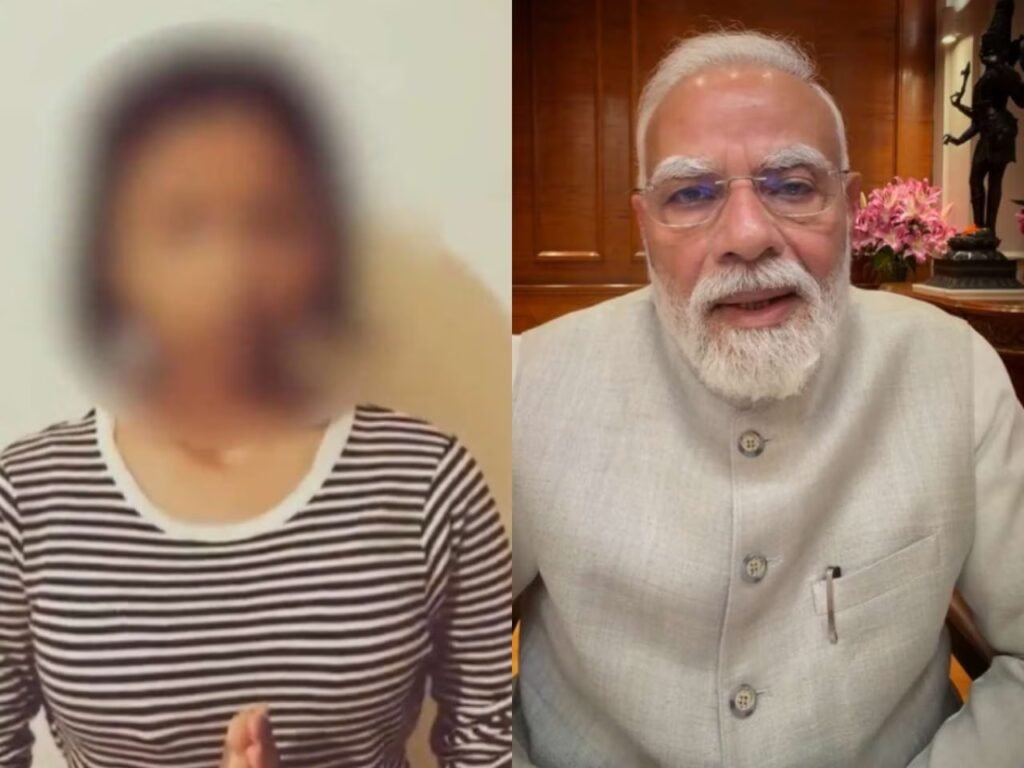
During the paper leak protest at Jantar Mantar in Delhi, abusive language was used against Prime Minister Narendra Modi. PM Modi released a video on social media on Saturday, August 1st. He expressed his forgiveness for the student who used abusive language during the protest. PM Modi stated that he and his late mother were abused during the protest. A video of the accused student has also surfaced in this matter. According to reports, the viral video shows the student claiming to be 15 years old, now pleading for forgiveness with folded hands. She claims she came to Connaught Place with friends to visit and joined the protest. She uttered abusive language under the influence of the crowd and in her excitement. The student also stated in the video that what she said was unpardonable and unforgivable. She stated that this was her first and last mistake, and that she apologizes to the nation and is deeply ashamed of her actions. She has realized the impact of her words and wants to apologize not only to the Prime Minister but to everyone across the country who was offended by them. The FIR reportedly lists her as 25 years old, but in the apology clip, she claims she’s only 15. She apologizes, saying she never intended to create such a controversy. Noida police registered a zero FIR The controversy began when a complaint was filed against the girl at a Noida police station on Wednesday for her comments about the Prime Minister. The Noida police registered a zero FIR and then transferred the complaint to the Parliament Street police station in New Delhi. The complainant stated that her comments had hurt the Prime Minister’s dignity and could vitiate the atmosphere and disrupt public peace. The student’s apology video surfaced just hours after Prime Minister Modi’s latest Instagram video, in which he appealed for restraint and forgiveness after abusive slogans were chanted against him during a student protest. In the message, he mentioned the recent events at Jantar Mantar, where some mischievous young men used language inappropriate for any civilized society and hurled filthy abuses. Responding to this, Prime Minister Modi stated that not only was he targeted, but his deceased mother was also treated very badly. Reflecting on the strong public reaction, Prime Minister Modi attributed this to childhood mistakes, noting that childhood offers the opportunity to correct those mistakes. Seeing the anger and resentment in society, he understood how deeply shocked people were by this student’s use of abusive language. He stated that the need of the hour is to embrace them and show them the right path. It is our duty to guide them; punishing them, dragging them to court, or harassing them in society will not change the situation. The Prime Minister clarified that he wishes to forgive them and hopes that society will accept their sentiments, stating that he has only one feeling in his heart.