
The 2026 West Bengal election marked a significant moment in Indian politics, not just because of the result but because of how the campaign was fought and won. With Narendra Modi leading the charge against Mamata Banerjee, the contest evolved into more than a traditional electoral battle. It became a powerful demonstration of how modern political communication, branding, and perception management can shape voter behavior. The outcome highlighted that in today’s digital-first environment, elections are influenced as much by narratives and emotional connect as by policies and ground-level issues.
At the core of the campaign was a carefully crafted aspirational narrative. Instead of relying solely on criticism of the incumbent government, the messaging focused on what Bengal could become in the future. Development, infrastructure, governance, and opportunity were positioned as central themes, particularly targeting young voters and urban audiences. This approach allowed the campaign to shift the conversation from dissatisfaction to possibility, creating a sense of momentum and change. It is a classic public relations strategy—when you give people a vision, you give them a reason to believe.
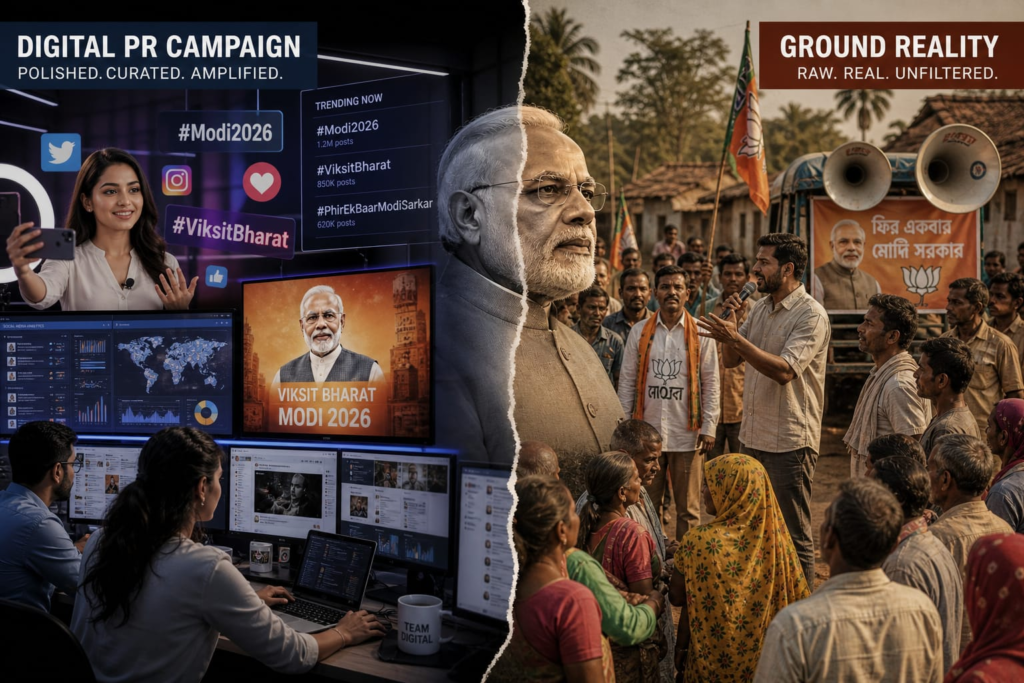
Equally important was the projection of Narendra Modi as not just a political leader but a strong and relatable brand. His image as a decisive and charismatic figure was amplified through rallies, speeches, and digital content. Each appearance was designed to build an emotional connection with voters, reinforcing trust and familiarity. In political PR, this is known as leader-centric campaigning, where the individual becomes the message itself. The Bengal campaign leaned heavily on this model, ensuring that the leader’s personality and narrative remained at the forefront of voter consciousness.
One of the most talked-about moments of the campaign was surprisingly simple—Modi stopping to eat jhal muri, a popular Bengali street snack. On the surface, it appeared to be an ordinary interaction, but in reality, it was a highly effective PR moment. The act symbolized cultural acceptance and local connection, sending a subtle message that the leader understands and respects regional identity. In an era driven by visuals and short-form content, this moment quickly went viral across social media platforms. It was shared, memed, and discussed widely, transforming a small gesture into a powerful narrative tool. The “jhal muri moment” demonstrated how symbolic actions can sometimes communicate more effectively than long speeches.
The role of digital media further amplified this strategy. Short videos, reels, and meme content ensured that campaign messaging reached a wide audience in an engaging format. Political communication is no longer limited to television debates or newspaper headlines; it now thrives on Instagram feeds, YouTube shorts, and WhatsApp forwards. The Bengal election showcased how digital ecosystems can be used to reinforce narratives, create relatability, and maintain constant engagement with voters. This blend of online and offline campaigning created a seamless flow of messaging that kept the campaign visible and relevant at all times.
However, the strong PR push also sparked debate. Critics argued that such moments were carefully staged and focused more on image-building than on substantive issues. Questions were raised about authenticity and whether symbolic gestures overshadowed real policy discussions. Yet, this criticism itself reflects the changing nature of politics. In a media-saturated environment, perception often travels faster than facts, and repeated exposure to a consistent narrative can significantly influence public opinion. Whether one views it as strategic brilliance or calculated optics, the impact of such PR efforts cannot be ignored.
Behind the scenes, the campaign was supported by robust organizational strength and grassroots outreach. Booth-level management, targeted voter engagement, and a well-structured party network ensured that the momentum generated by PR translated into actual votes. This highlights an important reality: while PR can create attention and shape perception, it must be backed by strong ground execution to deliver results. The Bengal election was not won by communication alone but by the combination of narrative-building and organizational efficiency.
In conclusion, the 2026 West Bengal election stands as a defining example of how political campaigns are evolving in India. It illustrated that elections are no longer decided solely by traditional factors such as caste equations or local issues but are increasingly influenced by storytelling, symbolism, and digital engagement. From grand visions of development to a simple plate of jhal muri, every element of the campaign contributed to a larger narrative framework. The key takeaway is clear: modern politics is as much about winning minds as it is about winning votes.